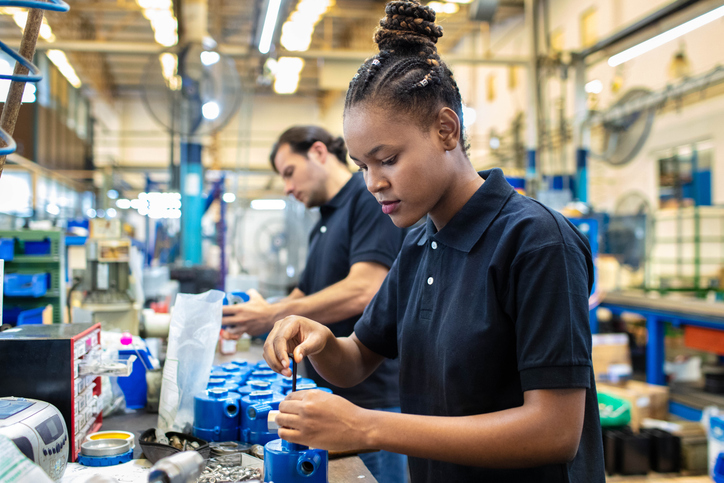
Enjoy putting the pieces together? Working as an assembler may be the right job for you. On an assembly line, workers focus on the construction or assembly of parts into completed products. Assemblers play a crucial role working at stations to put parts together, inspect quality, and ensure each product meets specifications. This division of responsibility allows assemblers to focus on efficiency while maintaining high standards.
Assembler Careers: What Do They Actually Do?
Assemblers put the pieces together to build, finish, and inspect products on an assembly line. There are all types of assemblers fabricating everything from electronics to furniture, motor vehicles to plastic products, and more. Assemblers work on assembly lines in a wide variety of industries, including:
- Aerospace
- Automotive
- Electronics
- Manufacturing
- Medical Devices
![Infographic illustrating an assembly line with three black conveyor belts carrying rectangular items; text reads “Assembly Line [ə-ˈsem-blē ˈlīn]” and “A production process that breaks the manufacture of a good into steps that are completed in a pre-defined sequence,” with the Investopedia logo at the bottom.](/wp-content/uploads/2026/04/AssemblyLine3-2-c9c005f8e3db48e4975a3172098852b2.webp)
In the U.S., 198,000 jobs for assemblers and fabricators are projected each year through 2034. In Canada, assembler jobs show stable to strong projections, depending on the type of assembly and location.
Production Line vs. Assembly Line
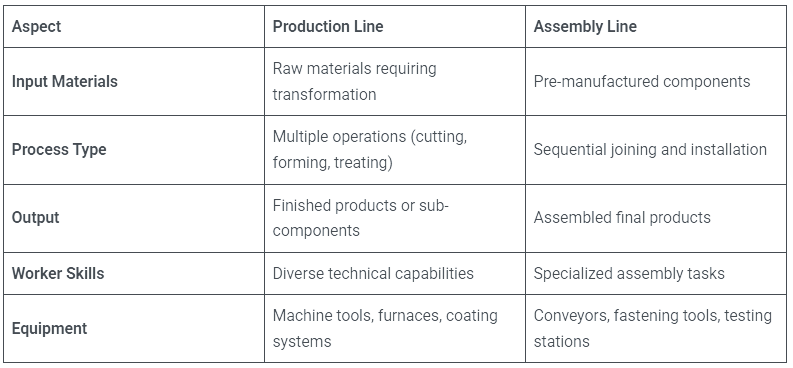
Assembler jobs are distinct from production roles. Production creates the pieces of products that assemblers build. For example, assemblers may put together car door mirrors after receiving the mirror, mirror cover, and other required parts, but they aren’t responsible for making the parts.
Plentiful Choices describes the processes, materials, skills, and equipment that vary from production line to assembly line.
What Skills Do Assemblers Need?
To succeed as an assembler, there are attainable skills to master. Education and experience requirements vary by employer and industry, but a high school diploma is generally sufficient. However, training and experience may be required for some roles.
- Ability to do repetitive tasks
- Ability to use tools (e.g. clamps) and machines (e.g. presses)
- Attention to detail
- Following procedures
- Following written and verbal instructions
- Mechanical skills
- Quality control
- Reading blueprints and schematics
- Strong hand-eye coordination
- Taking precise measurements
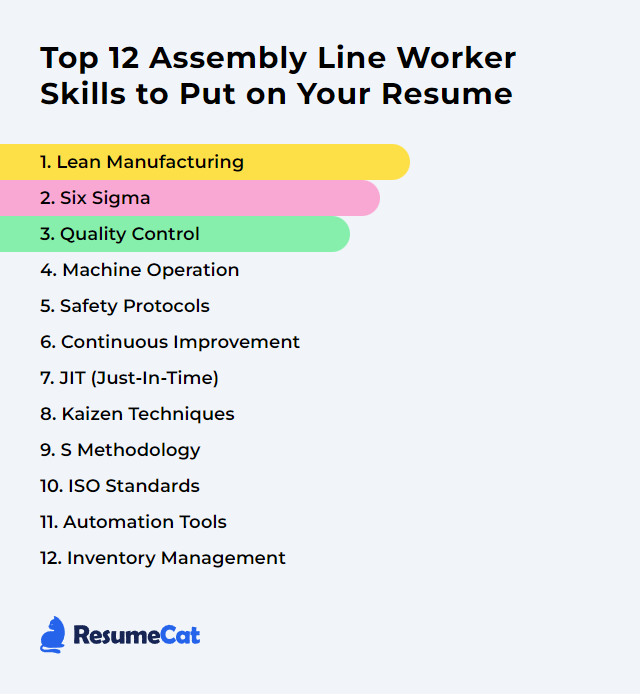
ResumeCat suggests assembler skills to include on your resume if you have the training or experience to match.
Assembler Job Titles to Look for
Assemblers can work in practically any industry and build a wide variety of products. If you’re ready to pursue a job as an assembler, expand your job search by looking for job titles like these:
- Assembler
- Assembly Line Worker
- Assembly Production Line Worker
- Assembly Supervisor
- Assembly Technician
- Construction Assembler
- Electromechanical Assembly
- Electronics Assembly
- Heavy Equipment Assembler
- Industrial Assembler
- PCB Assembly
Assembler Success
Assembler roles offer opportunities for detail-oriented work with immediate results as products are made. Many industries offer a range of assembler roles that cater to the interests and strengths of people who succeed at this job. Becoming an assembler takes the right skills and resources to connect with companies that are hiring. Let Express Employment Professionals help you build a rewarding career and achieve your goals.
About Express Employment Professionals
At Express Employment Professionals, we’re in the business of people. From job seekers to client companies, Express helps people thrive and businesses grow. Our international network of franchises offers localized staffing solutions to the communities they serve across the U.S., Canada, South Africa, Australia, and New Zealand, employing more than 11 million since its inception. For assistance with your job search, visit ExpressPros.com/Job-Seekers or ExpressPros.ca/Job-Seekers.
Last Updated on July 1, 2026
