
AI is revolutionizing healthcare, significantly altering how hospitals and clinics function. Healthcare leaders face the challenge of inspiring their teams to adapt to this rapid transformation.
The Wall Street Journal reports that AI will enhance roles, streamline workflows, and redefine expectations in care. Organizations that succeed will empower their workforce to embrace these changes, aligning human potential with technological advances.
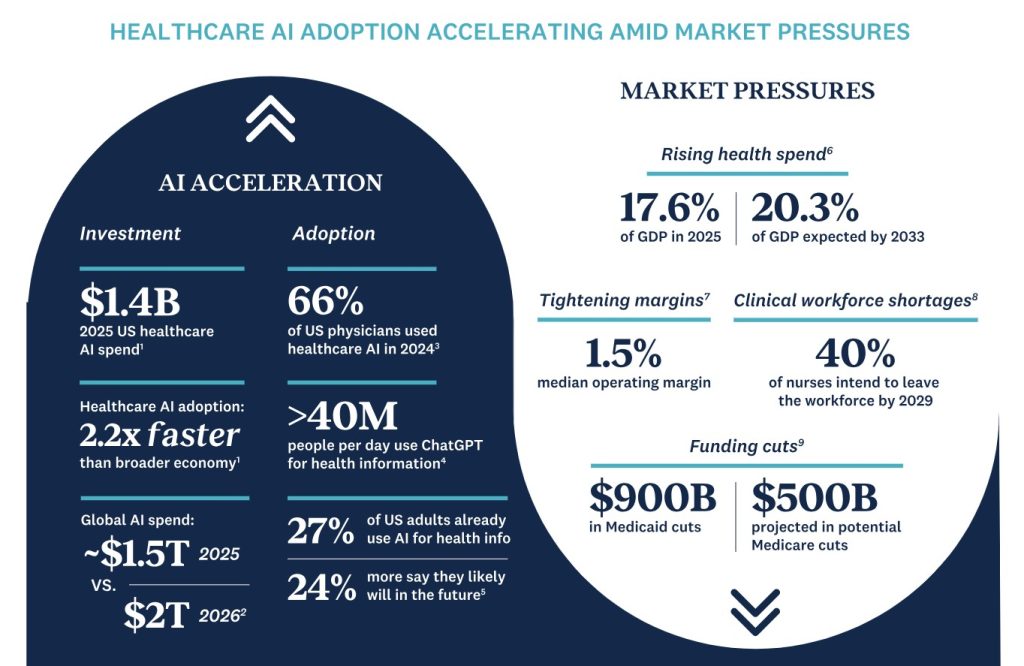
Courtesy of Chartis
The Workforce Reality Check Leaders Can’t Ignore
Economists predict that AI will reshape healthcare jobs in major ways: by accelerating the automation of administrative tasks, expanding AI-supported clinical roles, and increasing the demand for tech-augmented workers. The broader landscape also highlights an urgent challenge for leadership: the workforce is struggling to implement AI into its workflow. Key findings from a national workforce report include:
- 70% of healthcare professionals still don’t use AI daily, despite the availability of tools.
- 76% of healthcare leaders believe their organizations aren’t prepared for AI implementation.
- Recruiters report that only 10% of applicants receive human contact, as hiring teams struggle to manage the volume and integrate new technology simultaneously.
Where Is AI Already Transforming Healthcare Roles?
Across the healthcare industry, AI is reshaping roles more quickly than job descriptions can be updated. These changes don’t eliminate jobs; rather, they transform them. Leaders who succeed will be those who help employees transition to higher-value, tech-enabled work. Leaders should anticipate the following areas to undergo the most immediate transformation:
- Administrative Operations: Functions such as billing, scheduling, coding, and documentation are seeing the highest rates of automation. AI can reduce manual workloads by as much as 40–60% in certain systems.
- Clinical Documentation: Ambient AI scribes are becoming standard, relieving clinicians of hours spent on charting and improving accuracy.
- Patient Access and Navigation: AI-driven triage, chatbots, and scheduling systems minimize wait times and enhance throughput.
- Pharmacy and Supply Chain: Robotics and predictive AI are optimizing medication dispensing, inventory management, and logistics.
- Care Team Redesign: New hybrid roles are emerging, including AI-supported nurses, digital care coordinators, and virtual-first clinicians.
Why Healthcare Is Behind Other Industries—and What Leaders Must Do
Despite AI’s potential, healthcare is among the slowest sectors to adopt it. Factors such as regulatory complexity, risk aversion, and outdated legacy systems contribute to this hesitation. However, the most significant barrier is cultural: many healthcare professionals fear AI will replace them instead of supporting them.
Leadership must combat this narrative with clarity and transparency. AI shouldn’t be seen as a substitute for clinical judgment, empathy, or human connection; instead, it’s a tool that enhances these attributes. When leaders frame AI as a partner rather than a threat, adoption rates increase, and resistance decreases. AI adoption should be viewed not as a technology project but as a people strategy. Organizations that are advancing rapidly invest in training before implementing technology, redesign workflows, not just job titles, and communicate early, often, and honestly.
What Should Healthcare Leadership Prioritize?
To prepare teams for the next wave of AI-driven change, leaders should concentrate on:
- Upskilling and Reskilling: Develop AI literacy programs for all roles, not just for technical staff.
- Redesigning Care Teams: Transition from traditional staffing models to hybrid human-AI workflows.
- Strengthening Recruitment Pipelines: Use AI to streamline hiring while preserving human connection where it matters most.
- Investing in Change Management: Equip managers with the tools necessary to guide teams through periods of uncertainty.
- Creating Ethical Guardrails: Establish clear policies regarding data use, transparency, and patient safety.
- Measuring Impact: Monitor productivity, burnout, patient outcomes, and employee sentiment as AI tools are implemented.
AI isn’t the future of healthcare; it’s the present. However, technology alone won’t address workforce shortages, burnout, or operational inefficiencies. The true differentiator will be leadership. Those who invest in their workforce, communicate transparently, and foster a culture of adaptability will not only navigate the AI transition but will also shape the next era of healthcare work.
About Express Healthcare Staffing
Express Healthcare Staffing is in the business of people. We support local hospitals, clinics, and long-term facilities with exceptional medical professionals seeking new career opportunities. Through an individual approach to healthcare staffing, we help ensure the right fit for both the facility and the professional. For more information, visit ExpressHealthcare.com/Employers or ExpressHealthcare.ca/Employers. Find the location nearest you in the U.S. or Canada.